
How to Choose a Table Football Table
A good table football table can provide years of enjoyment, from family games and office competitions to club nights and tournament practice. But with so many options available, how do you choose the right one?
The best table for you depends on who will use it, where it will go and how often you expect to play. Appearance matters, but stability, playing quality and access to spare parts will make a bigger difference over time.
This guide explains what to look for before buying a table football table, also known as a foosball table.
Start with how you will use it
Before comparing brands and models, think about what you need your table to do.
| Where it will be used | What to prioritise |
|---|---|
| Family home | Smooth rods, suitable height, sturdy construction and features appropriate for children |
| Office or workplace | Durability, easy maintenance and enough room for four players |
| School or youth centre | Robust construction, suitable rod design and readily available replacement parts |
| Pub or public venue | Commercial construction, straightforward cleaning and a choice of free play or coin operation |
| Table football club | Consistent playing quality, durability and relevance to the competitions members play |
| Tournament practice | The specific table model and ball used at your target events |
–
A table for occasional family games has different demands from one used every lunchtime by a busy office. Buy for the level of use you expect, including how that might grow.
Put playing quality before appearance
A table can look impressive in a photograph and still be frustrating to play on. The most useful features are often the ones you notice only when you start a game.
Stability: The table should feel secure during normal play. Look for a solid cabinet, firmly attached legs and well-built joints. Weight can help, but it is not a substitute for good construction.
Smooth rods: You should be able to move and rotate the rods comfortably, without sticking or excessive resistance. Check every rod if you are viewing a table in person.
A flat playing surface: A warped pitch makes the ball drift and can spoil a game. Adjustable feet are useful for levelling the table on an uneven floor, but they cannot correct a damaged playing surface.
Consistent ball control: A good table should allow players to develop passing, control and shooting skills. The design of the players, the surface and the ball all contribute to how it plays.
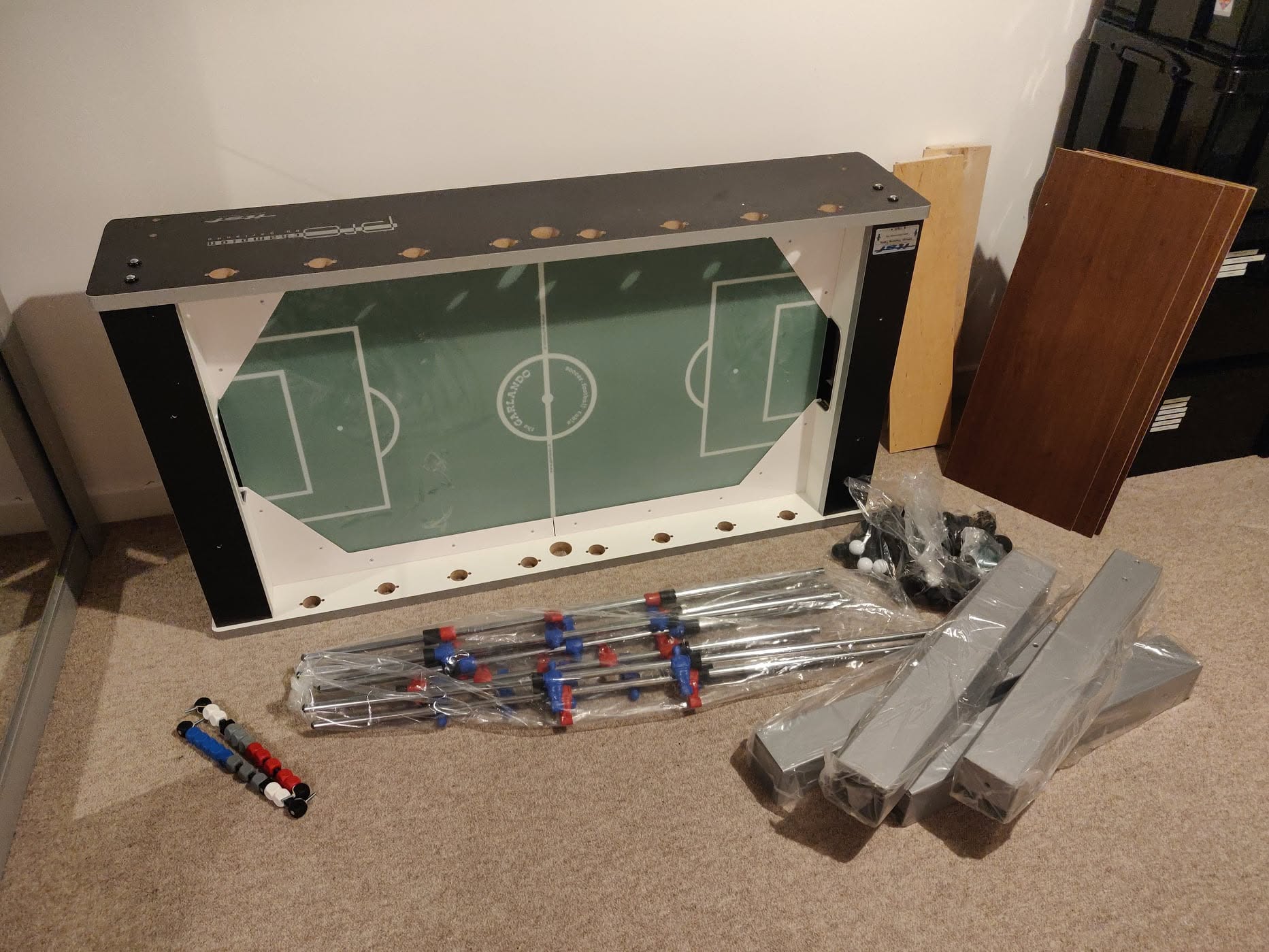
Replaceable parts: Balls, handles, players, bearings and bumpers can wear out. Before buying, check whether replacements are available for the exact model.
Measure the playing space, not just the table
One of the easiest mistakes is measuring the cabinet and forgetting everything around it.
You need room for the rods to move through their full range, players to stand comfortably on both sides and people to reach the ball returns. For doubles, two players need to share each side without feeling cramped.
Ask the supplier for the table’s dimensions including the rods, and clarify whether the stated width covers their full movement. Mark out the proposed position on the floor before ordering.
Also check the delivery route. Doorways, stairs, tight corners and access to an upstairs room can all affect installation. Find out how much assembly is required and whether delivery includes taking the table into your chosen room.
Think about children and accessibility
For younger players, check the table height and how comfortably they can reach and operate the handles.
Telescopic rods are worth considering wherever children will be playing or standing nearby. These retract within themselves instead of projecting through the opposite side of the cabinet. Garlando specifically recommends this design for locations used by children.
Do not assume that a smaller table will automatically be easier to use. A lightweight table with stiff rods can be frustrating even for casual games.
If wheelchair access or other accessibility requirements matter, discuss them with the supplier before buying. Check clearance beneath the cabinet, the position of the legs and access to the handles and ball returns.
Understand the differences between brands and models
Table football tables do not all play the same way. Differences in rods, player shapes, surfaces and balls affect the feel of the game.
Brands represented in international competition include Bonzini, Garlando, Leonhart, Roberto Sport and Tornado. They are useful starting points when exploring established table football manufacturers.
However, choose the model as carefully as the brand. A manufacturer may offer home tables, commercial tables, outdoor models and competition tables with different specifications.
If a table is advertised as ITSF approved, check the approval for the specific model. The presence of a familiar brand name does not mean every table in its range is the same as the one used at international tournaments.
For competitive players, a sensible starting point is the table used at your local club or the events you plan to enter. For home and social use, comfort, enjoyment and durability may matter more than matching a tournament setup.
Set a budget around long-term value
The purchase price is only part of the cost. Factor in delivery, assembly, suitable balls, maintenance supplies and any replacement parts the table may need.
A cheaper table can be a reasonable choice for occasional use, but compromises become more noticeable when people play regularly. Wobbling legs, stiff rods and an inconsistent playing surface can quickly discourage players.
Our advice is to prioritise the fundamentals:
- A stable cabinet and secure legs.
- Smooth, comfortable rods.
- A flat, consistent playing surface.
- Spare parts and after-sales support.
- A design suited to the people and location.
If your budget is limited, a well-maintained second-hand table from an established manufacturer may be worth considering alongside a new entry-level model.
Buying a second-hand table
A used table can offer good value, provided you check its condition carefully.
Whenever possible, see it assembled and play a few points before agreeing to buy. Look for:
- Bent rods, sticking movement or excessive looseness.
- Cracked players, loose handles and missing components.
- Warping, bubbling or other damage to the playing surface.
- Swollen cabinet panels or signs of damp.
- Loose legs, damaged fixings and missing levelling feet.
- Problems with ball returns or coin mechanisms.
Ask for the exact model and check the availability and cost of any parts it needs. A bargain can become expensive if major components need replacing.
Plan collection too. Confirm what can be dismantled, how it will fit into your vehicle and how you will move it safely.
Choose an outdoor model for outdoor use
An ordinary indoor table should not be treated as an outdoor table simply because it has a cover.
For a garden, terrace or other exposed location, choose a model specifically designed for outdoor use. Check the manufacturer’s care requirements, including whether a cover is required and how the table should be stored when unused. Even weatherproof models need appropriate care.
A garage or outbuilding also deserves consideration. Tell the supplier about damp, condensation or temperature changes so they can advise on suitability.
Use the right ball and look after the table
The ball is part of the playing setup. Different balls can change the speed, grip and control considerably, so start with the type recommended for your model. For tournament practice, use the ball specified for the competition.
Keep the playing surface clean, check fixings periodically and follow the manufacturer’s instructions for rod care. Use only cleaning products and lubricants suitable for that table.
Before buying, ask the supplier what routine maintenance involves. A table that is straightforward to maintain is particularly valuable in a workplace, school or public venue.
Try before you buy
If possible, play on the type of table you are considering. A few games can tell you more about its feel than photographs or a specification sheet.
Visiting a local table football club is a useful way to experience different tables and speak to people who use them regularly. Our find venues page can also help you discover places to play.
Notice how comfortable the handles feel, how easily the rods move and whether you enjoy controlling the ball. The right table should make you want to play again.
Your checklist before buying
Before placing an order, make sure you can answer these questions:
- Is the table suitable for the people who will use it?
- Is it designed for the amount of use and location you have in mind?
- Have you allowed enough room for rods, players and access?
- Can it be delivered and installed where you want it?
- Are spare parts available for the exact model?
- What do delivery, assembly and the warranty include?
- Have you checked its playing quality or tried a comparable model?
Need help choosing a table?
Whether you are buying for your home, workplace, school, venue or club, the British Foosball Association can help you think through the options.
Get in touch and tell us your budget, where the table will go and who will be using it.
If you only need tables for an event, explore our table football hire options, with table-only hire and the option to add experienced players to help bring your event to life.


